
World Clock: A Complete Overview
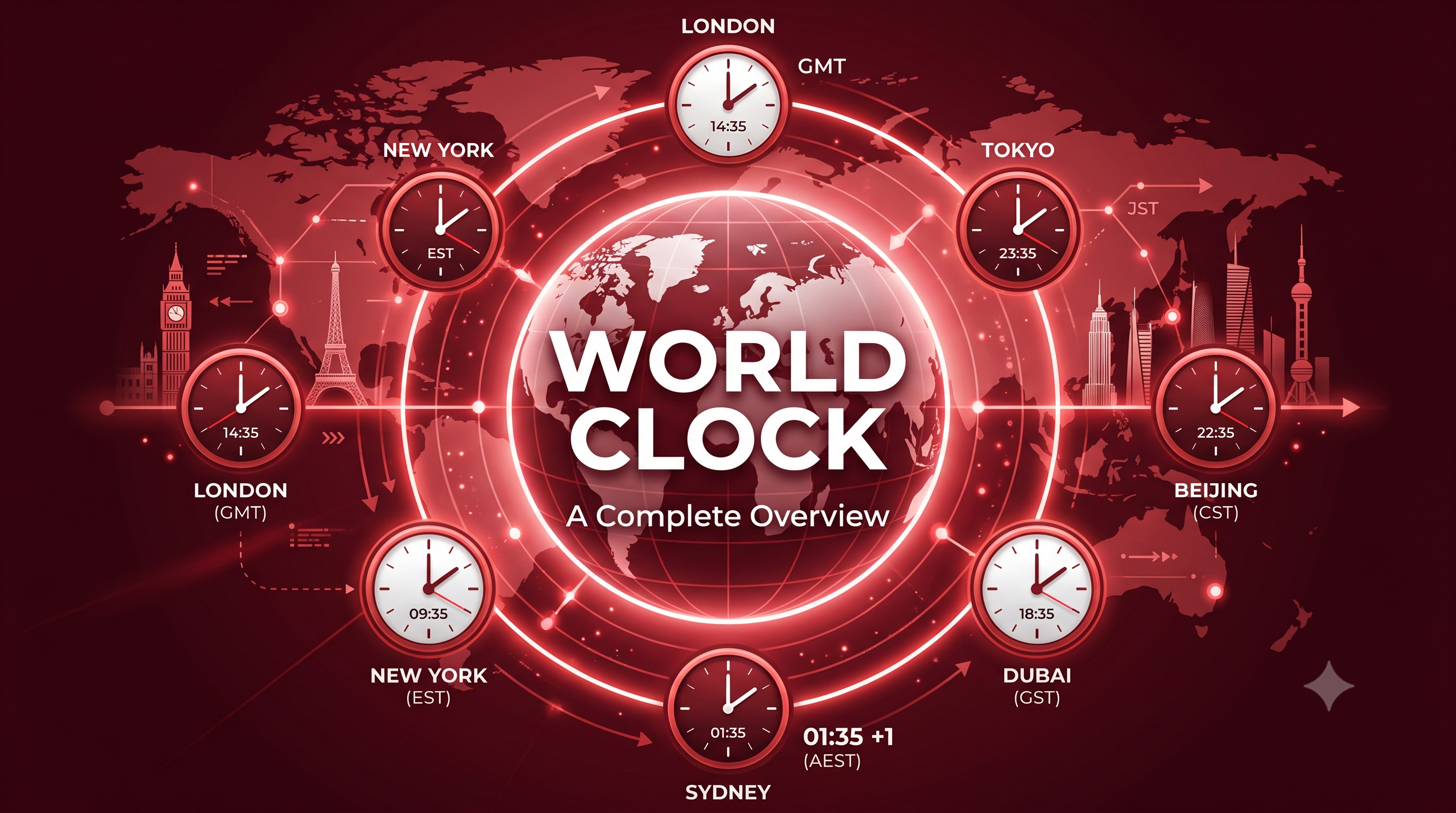
A world clock is a timekeeping tool that displays the current time across multiple cities and time zones simultaneously. It enables users to reference local times in different regions without manual calculation, supporting activities such as scheduling, travel planning, and cross-border communication. This article outlines the function, structure, and practical applications of world clock systems.
Definition
A world clock consolidates time data from multiple geographic locations into a single view. Each entry typically displays:
- City or region name
- Current local time
- Date (where it differs from the reference location)
- UTC offset
- Daylight saving time (DST) status, where applicable
World clocks are available as physical displays (commonly seen in airports, hotels, and financial trading floors) and as digital tools, including websites, mobile applications, and embedded widgets.
Time Zone Structure
Coordinated Universal Time (UTC)
All time zones are measured as an offset from Coordinated Universal Time (UTC), the primary global time standard maintained using atomic clocks. Time zone offsets range from UTC−12 to UTC+14.
Standard Offsets by Region
| City | Standard UTC Offset | Observes DST |
| New York | UTC−5 | Yes |
| London | UTC+0 | Yes |
| Dubai | UTC+4 | No |
| Mumbai | UTC+5:30 | No |
| Tokyo | UTC+9 | No |
| Sydney | UTC+10 | Yes |
Note: Offsets shift by one hour in regions observing daylight saving time during applicable months. DST start and end dates vary by country and are not globally synchronized.
Why Time Zones Exist
Time zones exist to keep local clock time aligned with solar position. Because the Earth completes one rotation every 24 hours, different longitudes experience daylight at different times. Dividing the globe into time zones allows clock time to correspond reasonably closely to daylight hours in each region.
Historical Background
Prior to standardization, localities set clocks independently based on solar observation. This created scheduling conflicts as rail and telegraph networks expanded in the 19th century.
In 1884, the International Meridian Conference established the Prime Meridian at Greenwich, England, as the reference point for global timekeeping. This conference laid the foundation for the modern time zone system, which has since been refined and is now maintained through the UTC standard.
Business and Operational Applications
| Use Case | Application |
| Distributed teams | Coordinating meeting times across offices in different regions |
| International trade and finance | Aligning market hours, settlement windows, and reporting deadlines |
| Customer support operations | Managing shift coverage across time zones for 24/7 service |
| Logistics and supply chain | Scheduling shipments, deliveries, and coordination with international partners |
| Travel and aviation | Calculating arrival and departure times, layovers, and itinerary planning |
| Event management | Publishing accurate start times for webinars, product launches, and livestreams to a global audience |
Core Features of a World Clock Tool
An effective world clock implementation should include the following:
- Real-time synchronization — Time values update continuously without requiring manual refresh.
- Customizable city list — Users can add, remove, or reorder tracked locations.
- UTC offset display — Each entry clearly shows its offset from UTC for reference.
- Automated DST handling — Offsets adjust automatically according to each region's daylight saving rules.
- Date differentiation — The tool indicates when the date differs between locations due to time zone separation.
- Search and filtering — Users can locate cities quickly by name or region.
- Time zone conversion or meeting planner functionality — Enables users to select a time in one location and view the corresponding time across all listed cities.
Data Maintenance Considerations
Time zone rules are not static. Countries periodically change UTC offsets, adopt or abolish daylight saving time, or redefine regional boundaries for political or administrative reasons. Reliable world clock systems typically reference standardized time zone databases, such as the IANA Time Zone Database, which is regularly updated to reflect these changes. Systems that do not maintain current data are at risk of displaying inaccurate times.
Summary
A world clock provides a standardized reference for comparing time across multiple locations, addressing a functional requirement created by global business operations, travel, and communication. Its reliability depends on accurate UTC offset data, correct handling of daylight saving time, and regular updates to reflect regional time zone changes. For organizations and individuals operating across borders, a properly maintained world clock is a practical tool for coordination and scheduling accuracy.
References
- IANA (Internet Assigned Numbers Authority). Time Zone Database (tz database). https://www.iana.org/time-zones
- Bureau International des Poids et Mesures (BIPM). Time Metrology — Coordinated Universal Time (UTC). https://www.bipm.org/en/-/2-utc
- International Telecommunication Union (ITU). Coordinated Universal Time: An Overview, ITU News Magazine. https://www.itu.int/hub/2023/07/coordinated-universal-time-an-overview/
- Wikipedia. International Meridian Conference. https://en.wikipedia.org/wiki/International_Meridian_Conference
- Wikipedia. Time Zone. https://en.wikipedia.org/wiki/Time_zone
- Wikipedia. Daylight Saving Time. https://en.wikipedia.org/wiki/Daylight_saving_time
Note: UTC offsets and daylight saving time rules cited in this article reflect standard definitions as of publication. Because national and regional time policies can change, readers building or maintaining time-dependent systems should verify current rules against the IANA Time Zone Database (Reference 1), which is updated periodically to reflect such changes.